

Suicide revisited
Introduction
At an age when they should have everything to live for, statistics show that many teenagers and young adults commit suicide each year, and this number continues to rise.
Taking your own life is unnecessary and premature. It not only deprives you of countless opportunities but also leaves behind immense pain, questions, and stigma. Suicide is the ultimate act of control – you have the power to decide whether to continue living or not. Your life is in your hands, and no one can stop you from making that decision.
I will always respect your choice to break free of all this pain of living, although you always have a choice. However, there are always options and there is always another way out. Suicide may just be so unnecessary and mistimed.
In an effort to prevent this unnecessary tragedy, I am dividing this article into two parts.
- First, I will try to get the loved ones of the person who wants to commit suicide to identify the signs of a possible suicide and get them to seek help in time.
- Secondly, I have written an open letter to the person who feels that there is no hope left, to get them to think again.
Warning signals of possible suicide
For the loved ones of someone who might be thinking of committing suicide, look for the following signs and seek help immediately.
How do we distinguish between a person just seeking attention and someone who really is about to commit suicide? The person serious about suicide may display some of the behaviour below.
Your loved one may:
- be obsessed with death, does research on it, having a specific plan for killing themselves, with the means, tools and/or determination to see it through;
- be sending out several suicidal threats, notes, or repeated statements about their death, especially if there was a previous suicide attempt. They cannot stop talking about a loved one who committed suicide and seems to be making final preparations, such as giving away possessions, setting up a will, and finishing unfinished business during their relationships with significant others;
- be trying to find old acquaintances to say their final good-byes;
- be appearing to have a sudden resolution of their challenges that seems to bring an unnatural calmness, which may be an indication that they see suicide as the ideal solution to all their challenges;
- have recently suffered a severe loss, whether through death, divorce or separation, or loss of someone dear to them, even the loss of a pet;
- have lost their job, experienced a drastic change in their financial security or status, or had to move house or change jobs suddenly;
- have experienced serious illness with or without chronic pain;
- display marked negative changes in motivation and behaviour and their work and performance have changed;
- be frequently late or absent without excuse;
- show a noticeable decrease in social activities, intentionally withdrawing from others;
- not be interested in hobbies or other interests;
- be aggressive, moody, tense, nervous, and restless;
- experience poor concentration and their thoughts appear scattered;
- have visible physical violations and self-inflicted injuries as they are becoming reckless, or may even take dangerous risks, such as driving extremely fast;
- abuse drugs or alcohol;
- experiencing a definite change in sexual behaviour;
- show a lack of interest in personal hygiene and appearance;
- be reluctant to make any future plans;
- show a noticeable change in personality – suicidal people often say they hate themselves or make statements that indicate that they feel worthless;
- feel hopeless, helpless, victimised, trapped, and believes no one appreciates them;
- feel as if they are a burden to others;
- show signs of acute depression and life is considered too difficult and painful;
- seem to cry easily and find no pleasure in anything;
- show physical symptoms such as the loss of appetite, changes in sleep patterns, permanent fatigue, and lack of energy;
- have a definite plan on how to change it;
- have previous suicide attempts by shooting, jumping, gassing, or hanging themselves. These attempts should always be taken more seriously than methods that can be perceived as more attention-seeking behaviour;
- have their plan well-planned and the person will ensure they cannot be found, rather than the cry for help attempts where the person will ensure they will be found and thus be saved.
A message to the suicidal ones
It always remains your choice to commit suicide if you really want to and there is nothing anyone can do to stop you. To commit suicide is certainly your right.
Suicide is indeed a potential solution. It is a way to get rid of all your challenges. I understand that you just do not want to hurt so much and I also have empathy for the fact that you do not really want to die. There are however better solutions.
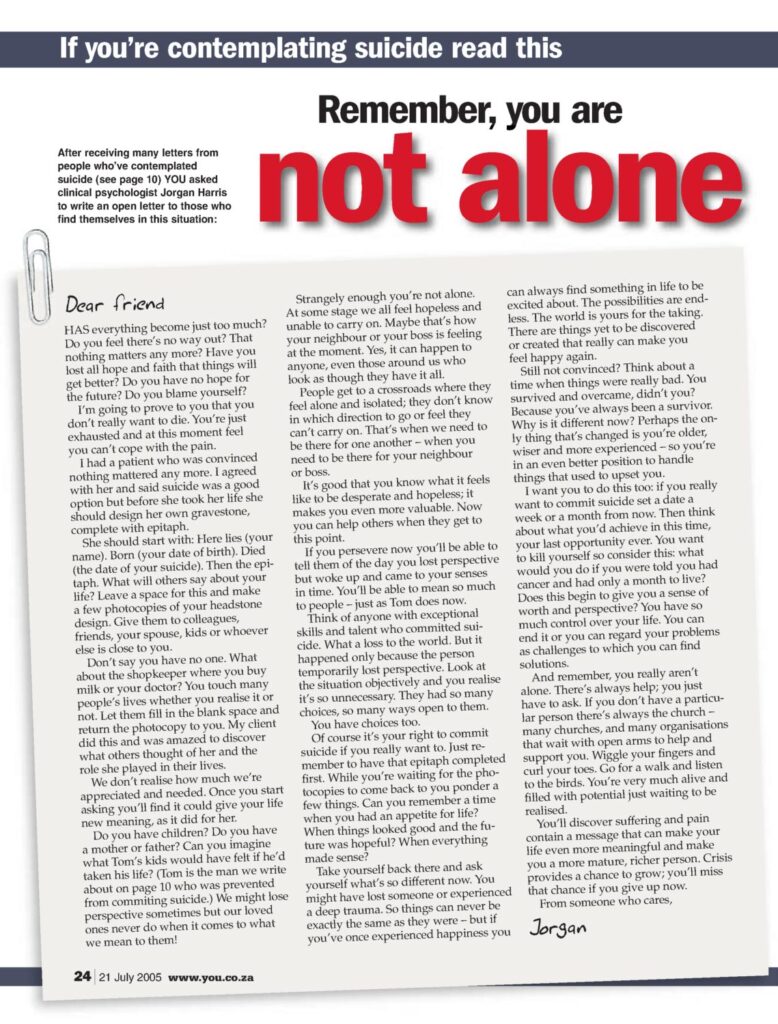
In an attempt to convince the suicidal ones otherwise, I published an open letter for them in YOU-magazine, published below courtesy of YOU-magazine.
In closing: Perhaps the idea of suicide is not all negative
You always have choices and you can choose to feel like a victim, or you can choose to seek different outcomes. At this point, you may feel like you have no other choice, but that’s because you’re not utilising all your resources to explore more options. There is no such thing as failure – you always have choices.
Rollo May, the father of the Existential School of Thought in psychology, once said the idea of suicide has saved many lives. It makes you realise how much control you have over your life; you have enough control that you could even end it anytime if you chose to. That sudden realisation of death’s finality might cause you to ask the question: what do I still want to do before I die? The longer that list becomes, the more answers you have for that question, and the more you realise how valuable your time here is. Faced with the finality of death, you begin to think about your potential future instead of just living day to day.
Interpretation
- A score of 0 -10 is seen as low. You may be sent home with advice to see someone to help you to re-assess your life
- 11 – 20 is seen as medium. Admission may be an option if you:
- are living alone
- has a history of previous suicide attempt; or
- are clinically depressed
- 20 – 30 is seen as high where psychiatric admission is recommended. Involuntary admission may be required.