

Brainworking Recursive Therapy® (BWRT)
What is BWRT
Whatever your challenge – it’s most likely that this amazing new therapy can help you to overcome and beat this challenge completely. BWRT is a modern methodology that incorporates the latest research into the technology of the brain and the way patterns of thought affect our well-being. If you have an idea of how you would like to be and feel, but just haven’t been able to get there, BWRT can help you find your way easily.
Neither the life-span of your challenge, nor how many times traumatic things happened to you, BWRT can help you to actually choose how you would like to feel about almost anything. It’s also a fact that most people do have unresolved issues. BWRT means you no longer have to linger upon these challenges and can literally put them quickly and effortlessly behind you.
BWRT was developed in 2011 by Terence Watts (assisted by his research partner, Rafiq Lockhat) and operates on the principle that our physical brain responds to events and makes decisions even before we physically become aware of them. The brain, however, is adaptable and capable of changing, growing and learning in a fast and efficient way.
BWRT is different from any form of conventional therapy since it does not ask unnecessary questions. It does not get stuck into the so-called analysis paralysis. It does not waste time. We are working with neurology and we are changing your neurology with neuroscience in a quick, safe and effective way.
BWRT also fits in with new thinking in the field of psychology. BWRT, like Mindfulness, NLP, Clinical Hypnosis and Positive Psychology, tends to move away from the traditional pathology model of psychology where the focus is directed on what is wrong with people. BWRT focuses on the moment, the here-and-now and on the future – where you want to be. BWRT can help you overcome your challenges, which is currently the reason why you just haven’t been able to get there yet.
BWRT is making use of a natural psychological processes to recondition negative neural pathways in the brain that lead to unwanted feelings, thoughts and behaviour. BWRT can stop and reroute the brain’s natural response to any trauma from a negative to a positive neural pathway that might stop the negative symptoms of conditions like depression and anxiety.
BWRT is not making use of any devices, advanced technologies or medication. BWRT is just a form of psychotherapy of talking and imagination and a few other surprises.
Watts believes that many physical health challenges are rooted in – or at least impacted by psychological challenges. BWRT can also be effective in coping with the symptoms of diabetes, multiple sclerosis, and a number of auto-immune diseases.
According to Watts, the purpose of BWRT is to give people the life they deserve, and that’s exactly what it does. It’s about giving people contentment in their lives, and making them feel equal to others. BWRT may just do that.
How does BWRT work?
The principle of how to learn something new, is by repeating the learning over and over again, until it becomes second nature. BWRT uses the same approach to learn new ways of responding to a situation or to change unwanted behaviour via repetition and reflection until we achieve the desired outcome. In doing so, the brain creates a new neural pathway network. BWRT focuses on changing undesired behaviour in favour of better behaviour. BWRT also uses your own powerful imagination and thought processes to reach your goals.
BWRT is unique and inspired by the research of the Virtual Nobel prize winner, Benjamin Libet (circa 1983). His research showed that there is a measurable waiting period (about ⅓ second) between the moment the brain commences to act upon any stimulus and our awareness of that action. In other words – by the time we realise what we’re doing, we’re already doing it as far as the physical brain is concerned.
Below is a schematic presentation explaining how the process works
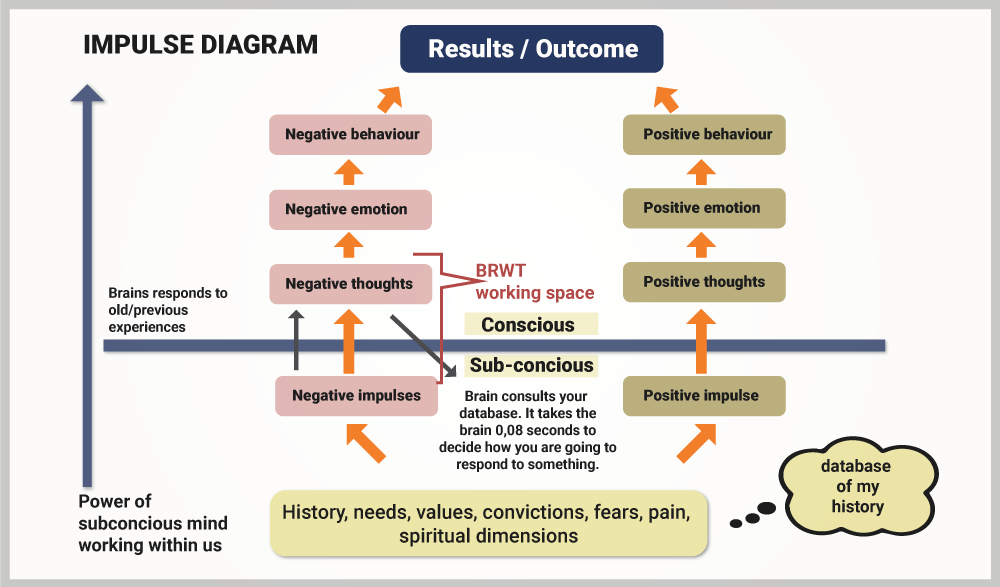
BWRT allows us the opportunity to work within that interval between the commencement of an action and the conscious awareness thereof. This gives us the opportunity to completely rewrite destructive thinking patterns. It will feel as if they were never there. I will tell you more about it later.
BWRT therapy is largely content-free, using your own thought processes and your creativity to release these symptomatic patterns. There is a strict protocol which ensures maximum effectiveness and the process is completely safe.
Specific challenges treatable with BWRT:
- any form of trauma;
- post-traumatic stress disorder;
- sexual trauma;
- rejection issues;
- trust issues;
- releasing negative emotions;
- stress and anxiety;
- panic attacks;
- habits, including smoking, gambling, eating, drinking, shopping etc.;
- fears, including fear of failure;
- self-confidence issues;
- phobias;
- obsessive compulsive disorder (OCD);
- relationship challenges;
- grief;
- depression;
- guilt;
Advantages of BWRT
BWRT is effective in helping people with a wide variety of psychological challenges – from depression and anxiety to obsessive compulsive disorder (OCD) and phobias. According to Watts – BWRT is extremely fast, often only taking one session to resolve these conditions.
He adds that BWRT has been used to treat people with post-traumatic stress disorder (PTSD), especially after conflict situation during war. After one session of BWRT treatment, soldiers could return to the field, compared to the three-week time frame normally associated with this condition.
BWRT is often referred to as a quick fix. In fact, BWRT is not just a short-term solution as it produces a deep, permanent change in people. Watts says the relapse rate following BWRT treatment is extremely low, with more than 99% of clients who had a positive response to the process of BWRT, without requiring any follow-up sessions.
BWRT is a new, revolutionary, highly effective and groundbreaking therapy as well as a dynamic model of psychology that fits in with the current thinking of neuroscience. It’s a fast-acting and effective way to cause change within the minimum number of therapeutic sessions, compared to other therapeutic systems.
Gone are the days of being month after month in therapy. You may be surprised as to how fast BWRT brings positive changes about. It does not matter where your challenge is coming from, how serious it is or for how long you are experiencing this challenge, the principle stays the same – all we need to do is to change our neurology, change our personal history. You may want to have another look at our Impulse-diagram. It is possible to happen within a session or two, depending on your challenge.
BWRT is a private process:
You will be able to address any challenge you may have with BWRT. You don’t even need to reveal any information of your challenge whatsoever. You will not be asked anything about your childhood, family, sex life, relationships, your past or anything else you would rather keep private, unless you feel the need to talk about it. BWRT is only interested in how you would like to feel, be or do.
BWRT is a rapid process
It does not matter what your challenge is, or how long you have been experiencing this challenge – BWRT is a fast form of therapy since the subconscious mind doesn’t know time.
BWRT is non-intrusive:
The work is done at a conscious level, and you will be completely aware of the process at all time. Due to the fact that we don’t have to go into the details of the trauma, will ensure that you will not be re-traumatised.
BWRT focuses on the outcome:
BWRT is not really interested in the origin of your challenge, or where it is coming from. BWRT is rather focused on the outcome – your future, where you want to be.
It does not matter how severe it was or how long ago it happened:
It does not matter how traumatic an incident was or how long you are having these symptoms. The brain does not work chronologically. It doesn’t know space and time – only emotions. It also does not concern itself about how serious an incident was or how severe your depression, anxiety or whatever symptoms, might be.
It also does not concern itself about how long ago it happened. We are focusing on the effect it has on you in the here and now. BWRT works with the interpretations of the emotions the challenge provokes in you in the here and now. The incident itself is only the trigger for your emotions and behaviour.
The results are permanent:
Once a new neural pathway is established, it cannot return to the old negative neural pathways.
What happens during a BWRT session?
Your brain is like a computer – all prototypes of computers are designed after the human brain. The software your brain is using is your memories. These memories can be triggers, resulting in challenges.
We are literally going to rewrite this old software (your memories) and replace them with new, positive, uplifting software.
You will be guided through the process with your eyes closed and in a completely alert state, until you have reached your desired state. Although you are fully aware of what is going on, you may not really understand what is really happening. During the approximate 20 to 25 minutes process, you will experience a significant relief of your symptoms that may be permanent. Processing the work we did during the session, can continue for up to 72 hours after our session and you may feel better or even worse for this period of time. It rarely happens – but be prepared – should you experience adverse symptoms, rest assured that this is a good sign, as your subconscious mind is busy developing new neuronal pathways.
During a session, you will be guided to use your own thoughts, fantasies and abilities – without me even knowing what those thoughts may be – to reach your desired changes. The process is completely logical, practical and down-to-earth. All you need to be successful, is for you to want to make positive changes in your life.
This is done in a special way to create a totally natural change that comes from within yourself, rather than from suggestions made by me. You don’t need to understand the complex neuroscientific theory behind BWRT to make a difference in your quality of life, though I explain it in detail in the next section.
The neuroscience behind BWRT
I would like to explain BWRT to you in two ways: The first approach is not necessarily academically correct, but will give you an idea of the mechanics behind BWRT. The second explanation is a more scientific approach for critical people.
A shorter and more elementary explanation
Your brain is made up of between 85 and 100 billion neurons and each one is connected to the next 1 000 or to as many as 10 000 other neurons.
Neurons can, in a sense, be compared to ears of wheat in a wheat field. Have you ever seen a wind blowing through a wheat field? It appears as if one ear of wheat is touching another, which in return touches the next one and so it goes on. It almost looks like there’s a pathway running through the wheat field.
Our brain works more or less on the same principle. We have billions of neurons in our brain. For every thought process we have, there is a neuron that touches another one, and another and another, and it forms what is known as a neural pathway.
Your brain consists of innumerable neurons. Can you think of how many innumerable different connections and neural pathways are running in your brain every moment of your life? You tied your shoelaces this morning, for which you need a neural pathway. You brushed your teeth and need a neural pathway for that. I do not even know how many neural pathways you need to drive your car or to practice your career.
According to BWRT, you are a perfect functioning individual, with all your billions of neuronal pathways running perfectly and in perfect directions. However, if there is only one single neural pathway running in the wrong direction, the whole system and outcome is negatively impacted.
By using only language and imagination, BWRT can help you change this neural pathway into a new neural pathway that may change your life.
We do not have to work through every issue of your life. Challenges with the same emotional theme are linked together, and will collapse all spontaneously, like a domino-effect. Thus, all dominos with the same emotional theme should collapse once you collapsed the most traumatic domino of your challenge.
A more complicated approach (optional and only for people who really want to know the neuroscience behind BWRT).
As mentioned, your brain is made up of between 85 and 100 billion neurons, which by the age of seven is almost grown out in weight and size. There is no further growth thereafter. However, a complex network of connections between cells is continuously happening in your brain every second of your life.
There are thousands of billions of such complicated connections.
Each neuron may be compared to an electric generator. Some neurons are running constantly while others fire intermittently as they receive messages from other neurons. Each of the nerve cells produces about 20 millivolts of power. Information is coded by the frequency of the impulses. We are able to see it on electroencephalographic tracings, the so-called E.E.G. An E.E.G. is a device that registers brain waves and prints it out on paper in the form of a graph.
The neuron consists of three parts:
- Cell body, which contains the nucleus;
- Dendrites, which form the branches or receiving wires that picks up messages from other neurons; and
- Axon, or sending wire through which messages are passed on after being evaluated by the nucleus.
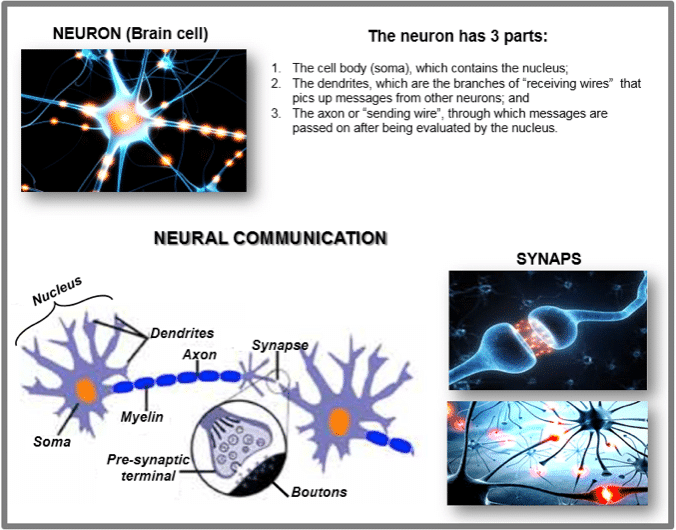
The sending wire of one cell does not touch the receiving wires of other cells. There’s a gap of a millionth of an inch between them, known as a synapse. The message should jump over this synapse. The next cell repeats the process. Brain messages can perform this jump 500 to 1 000 times per second, but the average speed is about 100 times per second.
There is no actual electrical connection, nor any passage of electric current between one neuron and the next. The sending wire of the cell ends in little protein vesicles called boutons (French for buttons). The actual transmission of a message across the synapse is a chemical reaction. Chemicals produced by boutons squirt the message across – like popcorn being able to pop and hop when heated. When an action is repeated, cells are being stimulated at frequent intervals. Boutons at the synapse now increase both in size and number, shortening the span over which the message must jump. The more boutons, the less energy is needed for action to occur, and habits might be formed. The more often we perform the action, the more firmly the new habit becomes settled. Boutons which transmit messages along habit path-ways are thought to be permanent. The name engram is given to the specific network of neurons in habit or memory chains that replay the same picture or movement with stimulation or association.
We cannot lose our boutons, but we can rewrite old ones.
Think for a moment of your habits. Now think of your boutons. How can you change your habits if you can’t get rid of your boutons – the faithful transmitters of years of economic stimulus-response messages? For instance:
- How are you – and the automatic answer: well thanks and you?
- Smelling smoke – light a cigarette;
- Hear the phone – answer it;
- Boss enters – look alert;
- Walk on the sidewalk – avoid cracks between tiles;
- Go to a wedding – become emotional;
- See a ladder – walk around it;
- See a patrol car – lift foot off the accelerator.
Our past behaviour becomes so firmly encoded in a verifiable system of physiological reality.
How can we change?
The encouraging discovery is that even though we cannot destroy the old boutons, we can adjust, grow and build new neural pathways around the old ones (like bypass heart surgery). The most important element in building new habits is not time, but energy.
Energy builds new habit pathways.
If we wish to succeed to create a new pathway in our brain, we need to regularly repeat an action to achieve what we want. In time, results will show. Wholeheartedness produces maximum energy. It does not matter what kind of energy the body feels – emotional, physical, sexual; all can be utilized to build new habits. Learning to dance is a good example of building new boutons.
To end with
Old, established habits can be rewritten through BWRT to bring about a more positive you.
All of this is possible during a 20 to 25 minute session using BWRT.